Computer Science
Artificial Intelligence
Overview of AI concepts including Deep Learning, Neural Networks, Machine Learning, and LLM Platforms.
This page covers the evolution and introduction of AI in brief. No discussing into the deep technical details.
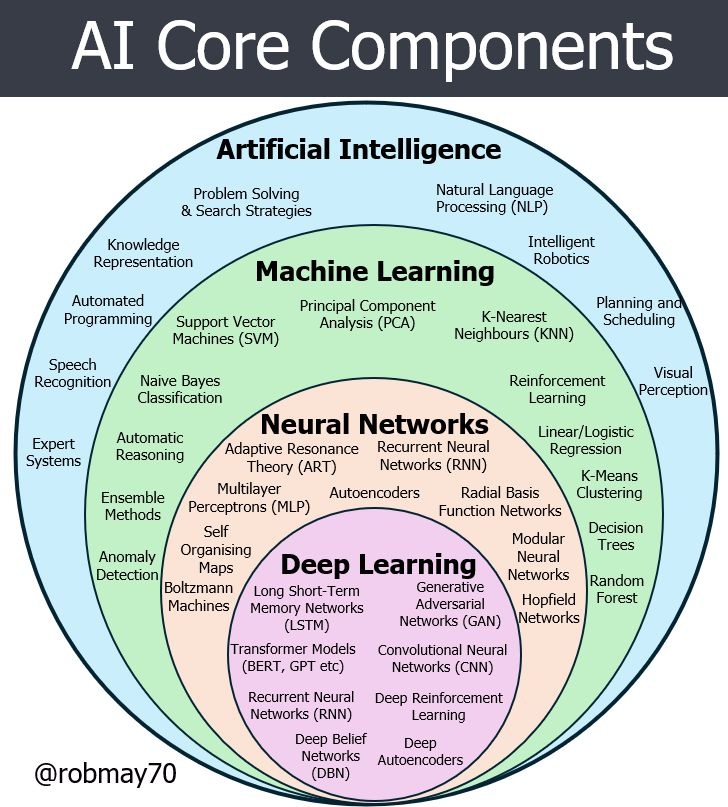
Neural Network Machine Learning
Neural Architecture
| Architecture | Year | Description |
|---|---|---|
| Multilayer Perceptron (MLP) | 1960s | A forward node is fully connected to all nodes in the previous layer. Mainly used for final classification tasks |
| Spiking Neural Network (SNN) | 1980s | Mimic real brain cells by processing information as discrete spikes, saving energy |
| Convolutional Neural Network (CNN) | 1990s | Uses convolutional kernels to learn spatial hierarchies in images. Ideal for computer vision |
| Recurrent Neural Network (RNN) | 1990s | A loop-based network for sequential data. Mostly superseded by more advanced architectures |
| Long Short-Term Memory (LSTM) | 2000s | Improvement of RNN with memory cells to store information over longer sequences |
| Graph Neural Network (GNN) | 2008 | Designed to process data represented as graphs (like social networks or molecules) |
| Deep Neural Network (DNN) | 2010s | Networks with many hidden layers that enable deep abstract understanding of complex patterns |
| Generative Adversarial Network (GAN) | 2014 | Two competing networks (Generator and Discriminator) used to create realistic images/videos |
| Transformer | 2017 | Uses self-attention to connect all nodes. The standard for LLMs and modern generative AI |
| Neural Radiance Field (NeRF) | 2020 | A method for generating 3D representations of scenes from 2D images |
Image Detection
Modern Machine Learning (Transformer)
| Technique | Description |
|---|---|
| Supervised Learning | The model learns from "labeled" data (input-output pairs) to predict answers |
| Unsupervised Learning | The model discovers hidden patterns or structures in data without pre-assigned labels |
| Reinforcement Learning | The model learns through trial and error to maximize rewards in a dynamic environment |
| Diffusion | A generative method that creates high-quality data (like images) by reversing a "noising" process |
| Distillation | A method to transfer knowledge from a large model to a smaller model |
| Mixture of Experts | Uses specialized sub-networks to selectively process different parts of the input efficiently |
Traditional Machine Learning
Traditional ML is mostly mathematically based and are not integratable to neural machine learning.
| Method | Description | Application |
|---|---|---|
| SVM | Finds the optimal hyperplane that maximizes the margin between different classes. | Classification |
| Naive Bayes | Uses Bayes' Theorem assuming independence between features to predict class probabilities. | Classification |
| K-Nearest Neighbor | Assigns a class based on the majority vote of the 'K' closest neighbors in the data. | Classification |
| K-Means Clustering | Iteratively groups data points into 'K' clusters based on their proximity to group centers. | Clustering |
| Linear/Logistic Regression | Models linear relationships (Linear) or predicts class probabilities (Logistic) from features. | Classification |
| Decision Tree | A tree-like model that makes decisions by branching based on feature value thresholds. | Classification |
| Random Forest | An ensemble of decision trees that combines their outputs to improve accuracy and stability. | Classification |