Large Language Model
Multimodal LLM
Different media is projected to the text dimension to enable the transformer to find attention between different modalities.
Chain of Thought (CoT)
CoT is a technique to make the LLM think step by step before generating a response to the user. The intermediate steps will generate a rationale for the model to think and decide the coming steps. This also gives the model capability to connect with outer world through RAG or MCP in the middle of the process.
Retrieval Augmented Generation (RAG)
RAG is a technique to embed external data into a vector database through a embedding model. The LLM will pass a prompt to the embedding model to get the most relevant data from the vector database and added to the model's prompt before generating a response to the user.
Model Context Protocol (MCP)
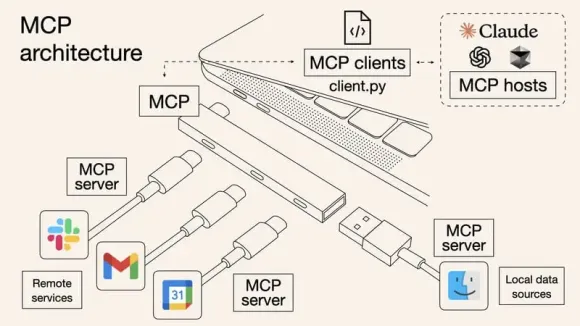
MCP is an open standard that acts as a universal way to connect different AI tools to any data source. The protocol enables LLM to understand what a MCP server can read and execute through JSON-RPC 2.0. The LLM can contact a MCP server to do specialized task like accessing database, compressing pdf and extract important facts, sending an email and many more.
Architecture
MCP follows a simple client-server model:
MCP Host
The application (like Claude Desktop or an IDE) that the user interacts with.
MCP Client
The component within the Host that manages the connection.
MCP Server
A lightweight service that exposes specific data or tools via the MCP protocol.
Connection Types
| Type | Communication | Details |
|---|---|---|
| Local | STDIO | Run as a system command line subprocess. |
| Remote | HTTP + SSE | Server-Sent Events over a web service. Connect via URL or IP. |
- Remote Hosting: Can be hosted on cloud platforms.
- Subprocess Workflow: The client starts a script using a fixed JSON format. It remembers the list of available servers and provides them to the LLM. During inference, the LLM decides which tool to call.
Efficiency: MCP vs. Browser
Using an MCP server (e.g. for web scraping) is significantly more efficient than a "headless browser" approach:
- Direct Access: LLM calls the scraper through the MCP server directly.
- Fall-back Drawbacks: Without MCP, systems fall back to a hidden browser to load the DOM. This is noisy and consumes a long context window unnecessarily.
Anti-Bot Detection
Websites use several methods to block bots/scrapers. MCP servers often need to account for:
- Observer Behavior: Monitoring the pattern of requests and interactions.
- HTTPS Headers: Checking for standard browser-like headers.
- IP Reputation: Checking if incoming IP addresses belong to well-known data centers.
- TLS Fingerprint: Chrome and Python use different encryption algorithms, which can be used to distinguish a real browser from a script.
Tip: The definitive guide to the protocol Official MCP Website